

DOJ’s National Fraud Enforcement Division Issues Inaugural Memorandum: Four Key Takeaways
On August 13, 2026, Assistant Attorney General Colin M. McDonald of the Department of Justice’s (DOJ) National Fraud Enforcement Division (NFED or the Division) issued a memorandum outlining the Division’s mission, organizational structure, and enforcement priorities (the Memo). The White House established NFED in April 2026. As discussed in a prior Sidley update, NFED is tasked with leading a whole-of-government effort to combat fraud “no matter its size or complexity.”
The Memo provides the most detailed public account to date of NFED’s mission, structure and enforcement approach and further underscores the Administration’s focus on anti-fraud enforcement as a signature initiative. Below, we highlight four key takeaways from the Memo and offer observations for companies navigating this evolving enforcement landscape.
- An Organizational Size and Structure Built for Permanence
According to the Memo, the Division will reach approximately 500 attorneys and staff by August 24, 2026, likely making it larger than the Criminal Division and one of DOJ’s largest components, if not the largest. The organizational chart published alongside the Memo further suggests that Assistant Attorney General McDonald is building the infrastructure for an enduring enforcement operation, rather than simply rebranding the former Criminal Division’s Fraud Section. NFED’s structure mirrors that of other DOJ Divisions: The Assistant Attorney General, currently McDonald, leads the Division, supported by a Principal Deputy Assistant Attorney General (PDAAG) and multiple Deputy Assistant Attorneys General (DAAGs), each of whom oversees specialized sub-sections.
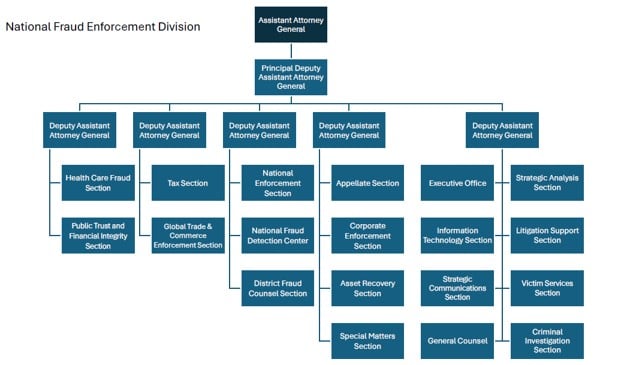
Notably, many of the Division’s sub-sections, including Health Care Fraud, Corporate Enforcement, Appellate, and Special Matters, are former units or sections transferred from the Criminal Division’s Fraud Section. Similarly, the Global Trade & Commerce Enforcement Section will build on the Criminal Division’s pre-existing Trade Fraud Task Force, while the Tax Section will likely draw substantially from the former Tax Division. This continuity may give NFED an immediate operational advantage: many of its prosecutors have worked together for years, and bring significant experience prosecuting program fraud and other fraud matters nationwide.
The organizational structure also reflects substantial investment capabilities beyond frontline prosecutors. Dedicated asset recovery, “strategic communications” or public affairs, administrative, data analytics, and litigation support personnel suggest that, as with the former Fraud Section, NFED’s litigating teams will be supported across the full lifecycle of an investigation and prosecution—from coordinating witness travel for grand jury appearances and victim notifications to conducting filter reviews of potentially privileged materials and pursuing forfeiture of allegedly tainted assets.
The role of the NFED’s newer sections is less clear. The National Enforcement Section, National Fraud Detection Center, and District Fraud Counsel Section may work with, or include, Assistant U.S. Attorneys detailed-in-place across each of the 93 federal judicial districts. If so, that model could give NFED a nationwide operational footprint extending beyond the geographic reach of the Health Care Fraud Section, whose prosecutors are based in Washington, D.C., and designated Strike Force cities.
DOJ will continue to pursue civil fraud actions separately, through the Fraud Section of the Civil Division. The Memo underscores NFED’s commitment to working closely with Civil Frauds to set priorities and pursue actions.
- Five Enforcement Priorities: A Broad but Public-Funding-Focused Portfolio
NFED’s enforcement priorities are consistent with its actions since its creation and with AAG McDonald’s prior remarks, as discussed in a prior Sidley update. Notably, the priorities remain largely focused largely on fraud involving public funds. It remains to be seen whether NFED will also pursue purely private fraud cases – i.e., schemes that do not implicate government programs or the potential misuse of taxpayer dollars. The Memo identifies five enforcement priorities:
- Public Trust and Financial Integrity. NFED will prioritize government contracting fraud schemes – including defective pricing, bid rigging, self-dealing, bribery, product substitution, and billing fraud – as well as benefit and grant program fraud spanning student loans, child care, veterans’ benefits, nutritional programs, disaster relief, and small business programs. This priority consists of a mix of some of what the precursor Fraud Section personnel focused upon as well as a flavor of the priorities discussed in the Executive Order creating the federal “Task Force to Eliminate Fraud.”
- Health Care. NFED will continue the legacy Fraud Section’s Health Care Fraud (HCF) Unit work in its Health Care Fraud Section, targeting Medicare and Medicaid fraud, telemedicine fraud, home health and hospice schemes, controlled substance diversion, and companies or individuals that deceptively market unsafe products and services. We anticipate continued regional and national takedowns in health care matters, as well as a continued emphasis on corporate cases.
- Internal Revenue. Following the dissolution of the Tax Division, NFED has absorbed at least some of the responsibility for criminal tax enforcement. Priority targets will include some of the Tax Division’s former bread-and-butter cases: return preparers who file false claims, individuals who conceal income or falsify information on their returns, and promoters who sell or facilitate illegal tax schemes.
- Global Trade and Commerce. Leveraging the pre-existing Trade Fraud Task Force, NFED will prioritize prosecution of customs evasion, supply chains “polluted by forced labor,” illicit transshipment schemes, country-of-origin fraud, and the undervaluation of imported goods. Civil and criminal teams have been active in this area for years but have notably increased resourcing since the Administration change.
- Corporate Misconduct. Finally, the Memo makes clear that across subject matters, NFED’s focus will not be limited to individual defendants—resolving a previously (somewhat) open question at the time of NFED’s creation. AAG McDonald, like other DOJ leaders, emphasizes rewarding companies that voluntarily self-disclose misconduct, cooperate with investigators, and remediate compliance failures. And like all other DOJ components (except the Antitrust Division), NFED will follow the DOJ-wide Corporate Enforcement and Voluntary Self-Disclosure Policy (CEP). However, the presence of the Fraud Section’s corporate enforcement and compliance personnel within NFED signals that they make take a more systematic and aggressive approach to government program fraud cases in which respondeat superior liability may exist.
- Institutional Backing and Empowerment
The Memo is consistent with prior statements by the Administration indicating that NFED enjoys strong White House backing and high-level political support, including from Vice President JD Vance. Three aspects of the Memo underscore the Division’s apparent mandate and resources: first, its substantial size; second, repeated references to NFED as the “national coordinator and leader” of anti-fraud efforts across the federal government; and third, its emphasis on the “considerable” resources available for deployment. The Memo also includes what amounts to a recruitment pitch, noting that new attorneys will begin their careers with “best-in-class training in our National Enforcement Section, where they will prosecute cases across the Division’s portfolio.”
- Data Analytics as a Force Multiplier
The Memo’s emphasis on data analytics, while consistent with prior statements from current and former DOJ leaders, warrants particular attention. Data-driven fraud detection has long been a feature of DOJ’s enforcement efforts, supporting the identification, investigation, and prosecution of government program fraud across a wide range of areas—from health care fraud and Paycheck Protection Program (PPP) fraud to Supplemental Nutrition Assistance Program (SNAP) fraud, stolen identity income tax refund (SIRF) fraud, trade fraud, post-9/11 GI Bill fraud, and beyond. The creation of the National Fraud Detection Center within NFED’s organizational structure suggests that the Division intends to institutionalize and expand these capabilities, making proactive data analysis a core investigative tool across its enforcement portfolio rather than a supplementary resource.
Observations and Recommendations
- Companies that hold federal contracts, seek federal contracting opportunities, and companies operating through or receiving money from federally funded programs or federal grants should evaluate their risk assessment and mitigation programs to ensure they are focused on current enforcement priorities and are leveraging data analytics to ensure compliance, identify issues early, and avoid worst-case scenarios should they find themselves in NFED’s crosshairs.
- We expect NFED to focus particularly on companies in the life sciences and healthcare sectors; defense contractors; and businesses with complex international supply chains. Financial institutions, even when not themselves enforcement targets, may also experience increased subpoena and information-request activity as NFED’s caseload expands.
- The Memo further reinforces DOJ’s emphasis on proactive engagement and voluntary self-disclosure, a topic discussed in a prior Sidley update. Under DOJ’s current Corporate Enforcement Policy (CEP), a pre-existing obligation to disclose misconduct does not necessarily render a company ineligible for a declination, provided there was no pre-existing obligation to disclose the misconduct to DOJ. Companies should nevertheless continue to carefully assess the calculus of whether and when to disclose, particularly because the DOJ-wide CEP does not bind DOJ’s Civil Division or eliminate or reduce potential civil liability, including under the False Claims Act.
This post is as of the posting date stated above. Sidley Austin LLP assumes no duty to update this post or post about any subsequent developments having a bearing on this post.