
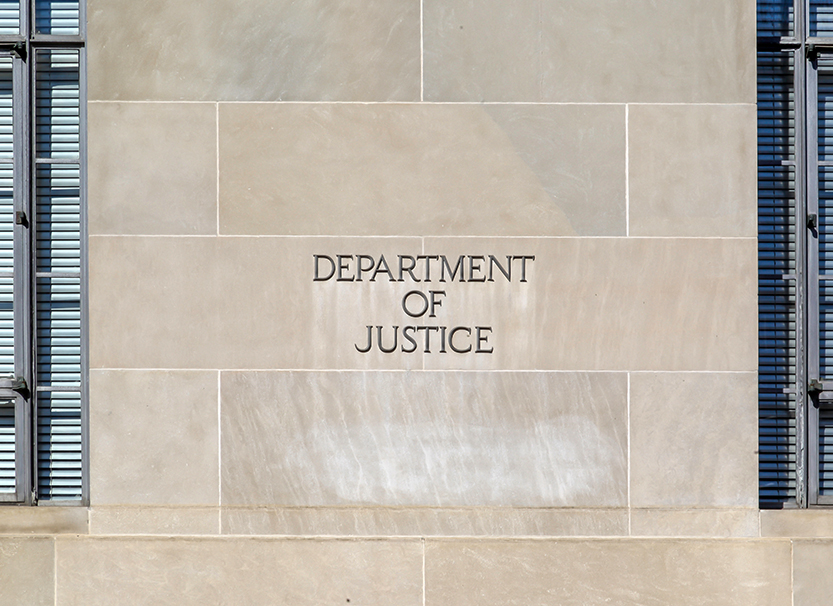
DOJ Ends 15-Year-Old Economic Espionage Case—With Prejudice
On July 13, 2026, the U.S. Department of Justice (“DOJ” or “Department”) filed a Notice of Dismissal bringing to an end a 15-year-old economic espionage prosecution.
In United States v. Pangang Group Co., the U.S. Attorney’s Office for the Northern District of California, joined by the DOJ’s National Security Division, moved to dismiss with prejudice the criminal charges against Pangang Group Company, Ltd.—a Chinese state-owned enterprise—and its three subsidiaries (collectively, the “Pangang Group Companies”). U.S. District Judge Jacqueline Scott Corley granted the government’s request the same day.[1]
The decision to dismiss the charges with prejudice is noteworthy in its own right. That DOJ did so after pursuing a first-of-its-kind prosecution deep into litigation (and in the middle of trial) makes the about-face all the more remarkable. The government’s case—which was the first prosecution to charge an enterprise owned by the Chinese government under the Economic Espionage Act (“EEA”)—alleged a decades-long scheme involving the Pangang Group Companies to steal trade secrets related to DuPont’s chloride-route titanium dioxide (“TiO2”), a commercially valuable white pigment used in a variety of products, for the benefit of the Chinese government.[2]
According to DOJ’s superseding indictment, Chinese officials identified chloride-route TiO2 production as a development priority in the early 1990s because Chinese companies had been unable to develop an efficient TiO2 production process. To obtain the technology, the indictment alleged, Chinese officials enlisted Walter Liew, a California-based engineer, who recruited DuPont employees to steal DuPont’s TiO2-related trade secrets. Between 1998 and 2011, Liew allegedly executed contracts worth roughly $28 million with the Pangang Group Companies, under which he supplied the misappropriated DuPont technology. The companies allegedly used that information to design TiO2 production lines in China.
For his part, Liew was indicted in 2011, convicted in 2014 for violating the EEA, and sentenced to 15 years in prison.[3] In 2012, the DOJ charged the Pangang Group Companies as co-defendants.[4] Over the next decade, the parties engaged in extensive pretrial litigation, during which the defendants suffered a series of significant losses.
A prosecution that reshaped the rules
The Pangang prosecution serves as a case study on the distinctive difficulties of prosecuting a foreign state-owned defendant. In doing so, it generated several precedential rulings that will continue to shape future economic espionage prosecutions despite the dismissal of the underlying case.
The Pangang Group Companies spent years contesting the validity of service of summonses, and the district court repeatedly quashed the government’s service attempts, ruling that delivering summonses to a U.S.-based affiliate did not satisfy the then-existing requirements of Federal Rule of Criminal Procedure (“FRCP”) 4.[5] Those challenges were consequential, as they helped prompt the 2016 amendments to FRCP 4, which clarified how the government may serve foreign organizational defendants that lack a U.S. agent or address.[6]
The defendants also challenged jurisdiction on sovereign-immunity grounds. That issue reached the Ninth Circuit twice. In 2021, the court held that the Pangang Group Companies failed to make a prima facie showing that they qualified as “instrumentalities” of a foreign state entitled to immunity under the Foreign Sovereign Immunities Act (“FSIA”).[7]
In doing so, the Ninth Circuit’s 2021 opinion underscored the important distinction between the EEA’s and the FSIA’s definitions of “foreign instrumentality.” The EEA defines the term broadly to include any entity “substantially owned, controlled, sponsored, commanded, managed, or dominated by a foreign government.” By contrast, the FSIA has been construed to require direct majority ownership by the foreign state.[8] Because the Chinese government lacked a direct majority ownership interest in the Pangang Group Companies, the Ninth Circuit concluded the defendants were not entitled to immunity under the FSIA.
The Pangang Group Companies later renewed their immunity arguments under federal common law. In 2025, the Ninth Circuit rejected those arguments as well, finding the companies had not shown they perform functions comparable to an agency of the Chinese government. The court emphasized that state ownership and control, without more, do not bring a corporation within the ambit of common-law foreign sovereign immunity.[9]
Although DOJ has now dismissed the prosecution with prejudice, those rulings are not erased. They continue to provide controlling Ninth Circuit precedent and are likely to inform how prosecutors and foreign sovereign defendants litigate immunity in the future.
Winning the motions, then folding at trial
The trial of the Pangang Group Companies began on July 7, 2026. One week later, the government elected to dismiss the case with prejudice.
The Notice of Dismissal provides no explanation for the government’s decision. What is clear, however, is that DOJ elected to end the prosecution only after more than a decade of litigation and after the trial had already begun. That timing along makes the dismissal unusual, particularly given the significance of the case as the first prosecution of a Chinese state-owned company under the Economic Espionage Act.
The dismissal also comes against the DOJ’s evolving approach to China-related national security enforcement. DOJ launched the China Initiative in 2018 to prioritize the investigation and prosecution of Chinese economic espionage and other national security offenses. In February 2022, the Department formally ended the Initiative, announcing it would fold its work into a broader strategy addressing nation-state threats from China, Russia, Iran, and North Korea.[10] Although the Pangang indictment predated the Initiative by several years, its conclusion is likely to be read as another data point in the evolution of DOJ’s China-related enforcement priorities.
Takeaways for companies and counsel
- Threshold wins do not ensure trial victories. Although the government defeated motions attacking service, jurisdiction, and immunity challenges, it still faced its burden of proof at trial, which proved formidable in this case given the decades-old cross-border conduct at issue.
- The procedural legacy outlasts the docket. Even though the government ultimately dismissed the case with prejudice, the litigation produced enduring precedents. The 2016 amendments to FRCP 4 and the Ninth Circuit’s two immunity opinions survive the dismissal and remain the governing framework for prosecuting foreign state-owned defendants.
- Criminal prosecution is only one tool among several. Alleged trade-secret theft by foreign competitors may also be addressed through civil litigation and the economic tools of the Department of Commerce, the Department of Treasury, and the U.S. Trade Representative. Indeed, the criminal forum is often the hardest and most resource intensive place to obtain a result.
[1]Notice of Dismissal, United States v. Pangang Grp. Co., No. 4:11-cr-00573-JSC (N.D. Cal. July 13, 2026), ECF No. 1525.
[2]See United States v. Pangang Group Co.: Ninth Circuit Holds that Certain Chinese State-Owned Companies Are Not Foreign “Instrumentalities” and Thus Lack Immunity Under the FSIA from Criminal Prosecution, 135 Harv. L. Rev. 1680, 1681 (2022).
[3]Press Release, U.S. Att’y’s Off. for the N. Dist. of Cal., Walter Liew Sentenced to Fifteen Years in Prison for Economic Espionage (July 11, 2014), https://www.justice.gov/usao-ndca/pr/walter-liew-sentenced-fifteen-years-prison-economic-espionage.
[4]Ninth Circuit Holds that Certain Chinese State-Owned Companies Are Not Foreign “Instrumentalities,” supra note 2 at 1681.
[5]See United States v. Pangang Grp. Co., 901 F.3d 1046, 1050 (9th Cir. 2018).
[6]See United States v. Pangang Grp. Co., 6 F.4th 946, 951 (9th Cir. 2021) (noting that Rule 4 was amended “[p]artly in response to the district court’s rulings in this case”).
[7]Ninth Circuit Holds that Certain Chinese State-Owned Companies Are Not Foreign “Instrumentalities,” supra note 2.
[8]Id. at 1683.
[9]United States v. Pangang Grp. Co., 135 F.4th 1142, 1157–58 (9th Cir. 2025).
[10]Speech, U.S. Dep’t of Just., Assistant Attorney General Matthew Olsen Delivers Remarks on Countering Nation-State Threats (Feb. 23, 2022), https://www.justice.gov/opa/speech/assistant-attorney-general-matthew-olsen-delivers-remarks-countering-nation-state-threats.
This post is as of the posting date stated above. Sidley Austin LLP assumes no duty to update this post or post about any subsequent developments having a bearing on this post.
Contacts
https://whitecollarwatch.sidley.com/wp-content/uploads/sites/8/2026/06/AdobeStock_330226534.jpeg 606 833 Sheila A.G. Armbrust http://whitecollarwatch.sidley.com/wp-content/uploads/sites/8/2026/03/sidleyLogo-e1643922598198.png Sheila A.G. Armbrust2026-07-17 13:09:362026-07-17 13:10:26DOJ Ends 15-Year-Old Economic Espionage Case—With Prejudice




You might also like
 DOJ’s Fraud Division Directs Broader Charging Strategies and Earlier Asset Seizures in New Memorandum